Synthetic-media instruments, by article and effective date
SceneMixer, read against Article 50
SceneMixer (scenemixer.com), an AI short-drama generator, is the one entry here whose marking statement sits in a compliance guide rather than a plan table. It describes a visible watermark on composited episodes, on by default, controlled by a settings switch. As of 2026-09-12.
Fig. 1 Filled where the page behind the row names something in that column, hollow where that page is silent. Silence is recorded rather than filled in.
What SceneMixer publishes, set against the two duties Article 50 imposes. Recorded 2026-09-12.
Point
What the vendor's pages state
Article 50(2), machine-readable marking
Not documented on the vendor's pages
Article 50(4), deployer disclosure
A visible watermark on composited episodes, on by default
To avoid two labels when the platform adds its own
Inclusion rule. Points are the same four for every generator recorded here: the two Article 50 duties, who controls the mark, and whatever the vendor states about it. A point the vendor does not publish is recorded as not documented. Order. Fixed order, identical on every generator page.
Fig. 2 One point at a time, every generator side by side, SceneMixer marked. This is a map of what the vendors publish, not a reading of the instrument. Wording in the rows below. Recorded 2026-09-12.
Every generator on one point, with SceneMixer marked. Recorded 2026-09-12.
Inclusion rule. Generators whose own public pages say something about marking. A generator silent on this particular point keeps its row, marked hollow. Order. Alphabetical by generator name.
Fig. 3 One point at a time, every generator side by side, SceneMixer marked. This is a map of what the vendors publish, not a reading of the instrument. Wording in the rows below. Recorded 2026-09-12.
Every generator on one point, with SceneMixer marked. Recorded 2026-09-12.
A visible mark on Basic-plan videos and on test-mode output
Inclusion rule. Generators whose own public pages say something about marking. A generator silent on this particular point keeps its row, marked hollow. Order. Alphabetical by generator name.
Fig. 4 One point at a time, every generator side by side, SceneMixer marked. This is a map of what the vendors publish, not a reading of the instrument. Wording in the rows below. Recorded 2026-09-12.
Every generator on one point, with SceneMixer marked. Recorded 2026-09-12.
Inclusion rule. Generators whose own public pages say something about marking. A generator silent on this particular point keeps its row, marked hollow. Order. Alphabetical by generator name.
A visible watermark is a deployer-side answer. It is what a viewer sees, which is the shape of the disclosure duty in paragraph 4, and it is not the machine-readable marking paragraph 2 asks providers for. Those are different obligations on different parties, and a product can satisfy one while saying nothing about the other.
The guide places the mark at compositing, the stage where separate generated segments become an episode. That matters for the creative-work narrowing in paragraph 4: the duty there is to disclose that generated content exists in a manner that does not hamper enjoyment of the work, and a mark applied to the deliverable rather than to every intermediate clip is consistent with that reading.
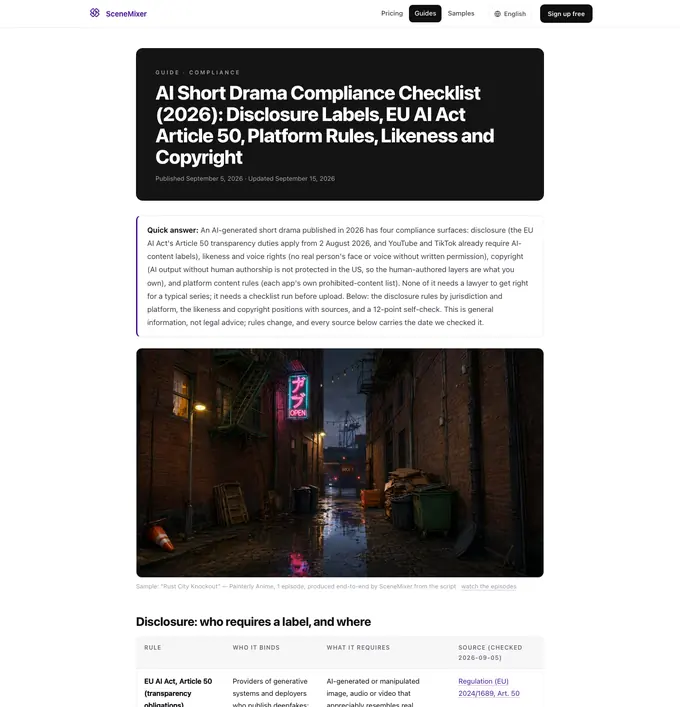
Fig. 5 The only source in this record written about the duty rather than about a product tier, which is why it names where the mark is applied.Screenshot of scenemixer.com/guides/ai-short-drama-compliance-2026, captured 2026-09-16. Reproduced to show where this entry was read from.
Nothing on the public pages names a provenance standard or lists a metadata field, so the machine-readable row says so. The guide does address the layer without enumerating it:
Keep whatever content credentials or generation metadata the tool writes. Re-encoding or re-exporting through an editor that strips metadata removes the automatic layer, and then the visible notice is your only evidence of compliance.
Read against paragraph 2 that sentence concedes the shape of the problem without claiming a solution: something is written, the vendor does not say what, and an ordinary export can remove it.
That warning is itself the most useful sentence on the page for anyone reading Article 50, because it names the failure mode the regulation's marking duty runs into: a signal that does not survive the ordinary handling of a file protects nobody, and the visible notice is what is left when it does not.
Four words is all a row holds. Where a cell read off SceneMixer's compliance guide needs the sentence behind it, the kind of document that sentence sits in and the limit on what it proves, it is filed on its own page below.
SceneMixer on a switch in settings — The guide describes an AIGC watermark switch that turns the visible mark off, and names no plan as the thing that unlocks the switch.
SceneMixer on a mark already on — The visible watermark is described as on by default, so an operator who changes nothing ships a marked episode without ever deciding to.
Read from the compliance guide at scenemixer.com on 2026-09-12. The clause itself is recorded on the Article 50 page, and every generator on the same points is in the table.
SceneMixer (scenemixer.com)
A visible watermark is applied to composited episodes and is on by defaultan AI short-drama generatorSceneMixer, compliance guide/ recorded 2026-09-12
SceneMixer
Controlled by an AIGC watermark switch in settings, which the guide says can be turned offuser control over the visible markSceneMixer, compliance guide/ recorded 2026-09-12